

OTTAWA — Prime Minister Mark Carney is travelling to Manila this week for the Association of Southeast Asian Nations (ASEAN) summit, where the ongoing Rohingya refugee crisis is expected to be a major topic of discussion as nearly one million displaced people remain in overcrowded camps in Bangladesh with no sign of repatriation.
Carney arrives in the Philippine capital on Saturday as a guest of the ASEAN chair, where he will also work to finalize a Canada-ASEAN free trade agreement expected to unlock more than $3.5 billion in exports and aim to conclude a new bilateral trade deal with the Philippines . But the humanitarian crisis stemming from Myanmar’s military campaign against the Rohingya nearly a decade ago will loom over the summit.
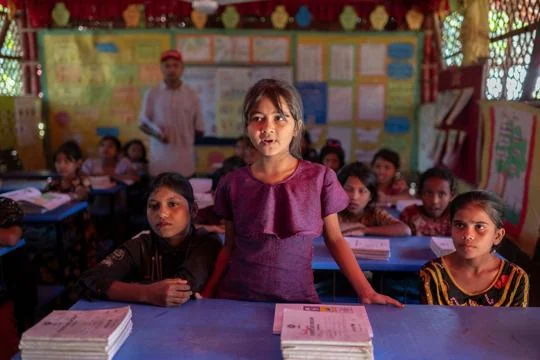
Randeep Sarai, Canada’s secretary of state for international development, said the federal government is not abandoning the nearly one million Rohingya expelled from Myanmar into Bangladesh. Sarai visited the world’s largest refugee camp in Cox’s Bazar last month, where he met children born in the camp nearly a decade ago. “They’ve only seen one life, which is at a refugee camp,” he said .
The Council on Foreign Relations estimates that almost a decade ago, Myanmar’s government launched a military campaign that forced roughly 700,000 Rohingya to flee. Rights groups suspect the government committed genocide, allegations Myanmar denies . The International Court of Justice is set to rule later this month on whether Myanmar has committed an act of genocide against the Rohingya minority .
The crisis has only deepened since the 2021 military coup in Myanmar, which intensified ethnic violence, often through airstrikes. Amnesty International reported in October that 150 to 700 new Rohingya refugees have been arriving weekly in Bangladesh . Bangladesh’s Home Minister said Wednesday that more than 1.5 million Rohingya are now taking refuge in the country, calling for coordinated international action to ensure their safe, voluntary and dignified repatriation .
Bob Rae, Canada’s ambassador to the UN and former special envoy to Myanmar, told The Canadian Press that the crisis has worsened as global attention has shifted to Ukraine, Gaza and Iran, and as Canada works to rebalance its trading relationships. “It remains a challenge for the Canadian government to put it at a high enough level of priority, when the country’s facing a whole bunch of other crises,” Rae said .
Rae noted that Canada’s funding for Rohingya programming has decreased since the crisis began in 2017, and Ottawa folded its Rohingya programming into general aid programming in 2024. He argued that pressure from ASEAN countries will only work if Canada and others provide enough aid money and convince India and China to help more .
Sarai said there is “a lot of pressure” on ASEAN countries. “We feel that they have a duty to work and put pressure, to make Myanmar bring [Rohingya refugees] back and give them a safe place,” he said .
The ASEAN bloc agreed in 2021 to a five-point plan involving a ceasefire—which never materialized—followed by negotiations, mediation, an influx of aid and a delegation to Myanmar. The instability has also caused Rohingya and others to flee to countries across Southeast Asia, including Malaysia, where 126,000 people live as undocumented migrants. Meanwhile, scam centres in Myanmar have engaged in human trafficking, luring people from multiple countries into forced labour—a spillover that Rae said is a source of deep concern for the entire region .