


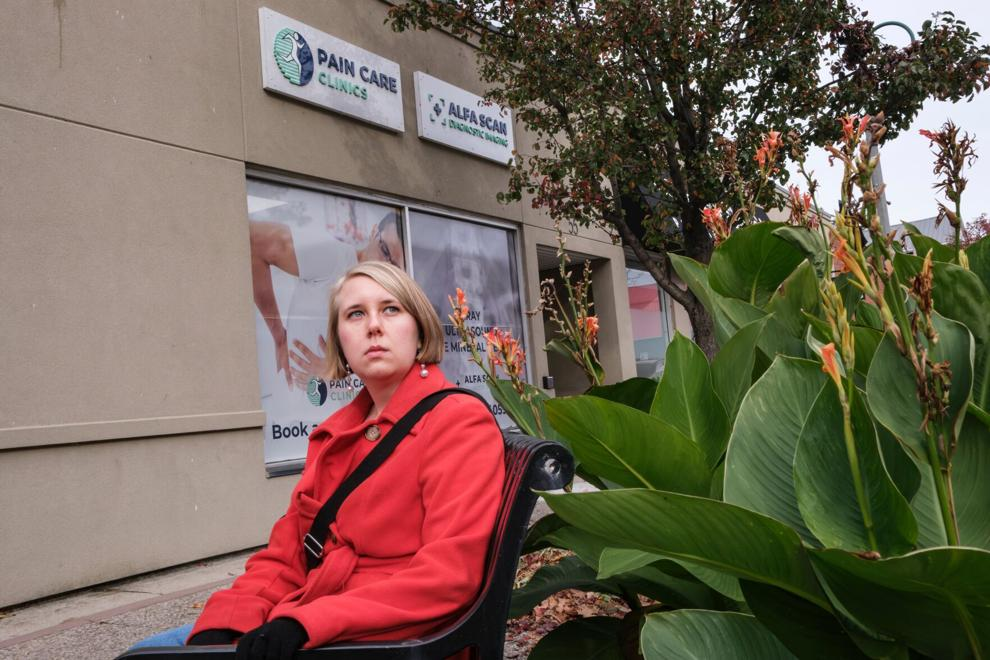
Every week for the past two years, Nadia Lopez has sat on an examination table as a doctor stuck 10 needles into her back and shoulders. The weekly nerve block injections, she says, are the only thing that lets her manage her chronic pain.
She was devastated when her doctor told her the Ontario government is considering cuts to OHIP coverage that could sharply limit how often she can get the injections—and force some pain care clinics to close. When she looked for details, she found only a campaign launched by clinics to rally patients to “save pain clinics” .
Lopez is caught in a fraught corner of health care, where the easiest treatments to get for chronic pain are not necessarily the ones backed by evidence. Physicians working in community pain clinics say they have been told by their representative to a joint Ontario Medical Association and Health Ministry committee that discussions are underway to reduce public funding for the nerve blocks that many patients have come to rely on .
Neither the OMA nor the ministry responded to specific questions about whether limits on OHIP coverage for nerve blocks are being proposed. The OMA said it “recognizes the importance of access to care for patients living with chronic pain” but such matters are dealt with in a process with the province. The ministry said only that OHIP coverage remains unchanged .
One in five Canadians lives with chronic pain, defined as pain that persists for more than three months, often with no identifiable cause or long after the body has healed from an injury. The gold-standard, multidisciplinary approach—combining physical therapy, psychological support and, in some cases, medication or limited interventional procedures—targets the body and brain’s pain pathways together, experts say. But patients often wait years for ministry-funded multidisciplinary services, according to Pain Ontario. What’s easy to find, and publicly funded, are nerve block injections .
Dr. Anuj Bhatia, a pain physician involved in developing new national guidelines published last month, said there is no evidence that regular, repeat nerve block injections are an effective way to treat chronic pain. Nerve blocks can be used as a diagnostic tool or to deliver numbing anesthetic or anti-inflammatory steroids for short-term relief. “There’s certainly a billing code for these injections and enterprising people are using the code but, outside of that, I don’t understand what the clinical rationale is for doing this repeatedly,” he said. “Outside Ontario, no one is really doing this kind of practice” .
A 2020 Star investigation found that Ontario’s top-billing pain doctors, working in privately owned clinics, gave patients weekly injections under loose limits on publicly funded nerve blocks, despite the lack of evidence they work. Ontario has previously proposed reining in billings but not followed through in the face of pushback from the OMA and patients rallying around clinics .
Jason Busse, scientific director of the Michael G. DeGroote Institute for Pain Research and Care at McMaster University, said chronic pain is vastly underresearched and the roughly three million Ontarians who live with it suffer enormously. “They’re desperate. They’re looking for solutions,” he said. “You can get lots and lots of treatment that doesn’t have much evidence for effectiveness, and it can be very hard to get therapy that does have evidence.” He was involved in a 2023 study of 562 chronic pain patients receiving nerve blocks in Ontario’s community clinics. They reported pain relief and functional improvement, but most attended clinics weekly for more than three years and the majority who were not retired were still unable to work. “That’s a lot of nerve blocks that people are getting … I think it’s reasonable to ask what it is accomplishing” .
Still, Busse understands why the prospect of losing this treatment is terrifying for patients .
The advocacy group Save Pain Clinics is calling on the Ministry of Health and OMA to confirm the status of any proposals, make evidence public, consult patients and physicians, and assess the impact on access and continuity of care, particularly in rural and underserved communities .