

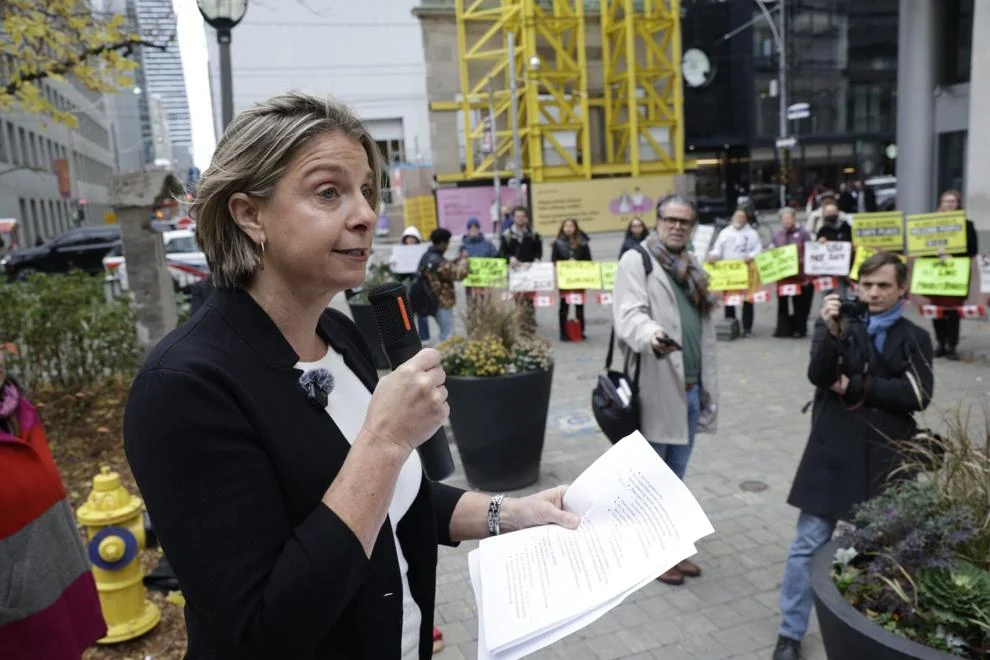
TORONTO — Canada’s Federal Court heard arguments this week in a constitutional challenge to the Safe Third Country Agreement (STCA), with litigants arguing the border pact disproportionately harms racialized women, children and LGBTQ refugee claimants by returning them to a U.S. asylum system they describe as fundamentally deficient and increasingly dangerous.
The lawsuit, led by the Canadian Council for Refugees, Amnesty International Canada and the Canadian Council of Churches, along with individual claimants, asks the court to declare the U.S. designation as a safe third country “invalid and of no force or effect” . A ruling in their favour would effectively reopen Canada’s land border to asylum seekers crossing from the U.S., allowing them to make a claim and enter Canada .
The case centres on Section 15 of the Canadian Charter of Rights and Freedoms, which guarantees equality rights. Lawyers for the plaintiffs argued that while the STCA appears neutral on its face, its operation produces discriminatory impacts on specific groups .
The Evidence Presented
Lawyer Kate Webster told the court that women fleeing gender-based persecution are often denied protection in the U.S. due to restrictive interpretations of refugee law. The lawsuit cited a documented case involving a Mexican schoolgirl who was kidnapped and repeatedly raped but was denied asylum because she could not prove her perpetrator raped her “on account of her gender” .
Children are held in “deplorable conditions” in U.S. detention, causing “profound and lasting” harms, Webster said. LGBTQ individuals face particular risks of sexual abuse, discrimination and harassment in immigration detention, and are often denied medical and mental health treatment. Things have worsened for transgender women after the Trump administration issued an executive order recognizing only male and female sexes, Webster noted—U.S. Immigration and Customs Enforcement “closed transgender dedicated pods,” leaving transgender women housed with men or placed in solitary confinement .
Canada returned 4,323 claimants to the U.S. between Jan. 1, 2025, and March 30, 2026, according to court submissions. Of that total, 2,078 were recorded as female and 860 were children under 17; the majority were racial minorities .
Ottawa’s Defence
Federal government lawyer David Knapp argued that the plaintiffs’ case rests on a “factual void,” pointing out that both the Salvadoran and Syrian families who initiated the lawsuit ultimately made it to Canada and acquired permanent residence . He argued there is “no direct non-hearsay evidence before the court of a person who was returned under the STCA and who did not have a fair asylum adjudication process” .
Knapp also contended that the U.S. asylum system falls within a “margin of appreciation” under the U.N. Refugee Convention, which provides a framework for member countries to run their asylum systems but does not impose uniform practices . He noted that returnees from Canada are not automatically detained, and that while millions of migrants are in the U.S. without status, only about 70,000 were held at any given time .
On the question of whether Canadian courts can apply the Charter to U.S. law and practice, Knapp argued the plaintiffs’ “entire argument was about American law and asking you to find that it violates section 15” of the Canadian Charter .
The Broader Context
The hearing follows a 2023 Supreme Court of Canada ruling that upheld the STCA against a Section 7 challenge but sent the equality rights question back to the Federal Court for reconsideration, noting the “profound seriousness of the matter” . The court heard this week that the risks have intensified since January 2025, with the Trump administration’s mass detention and deportation campaign .
More than 130 U.S.-based immigrant-serving organizations and experts issued a rare joint statement this week declaring the United States is not safe for asylum seekers, calling on Prime Minister Mark Carney to pause the STCA until conditions improve .
“The United States is not a safe place for migrants and refugees, particularly those who are racialized women, children, or LGBTQI+ people,” said Ketty Nivyabandi, secretary general of Amnesty International Canada. “The practice of sending some of the most vulnerable people in society back to the U.S.—right into the hands of ICE—is unjust and un-Canadian” .
The hearing is scheduled to continue on Dec. 16, with Judge Mandy Aylen presiding .