


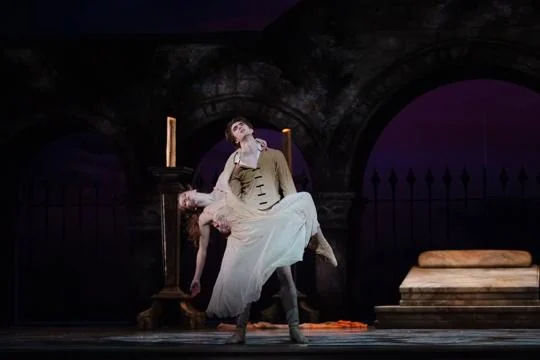
TORONTO — Imagine the pressure. You’re relatively junior dancers in a major ballet company, cast to make your debuts in two of the most coveted roles in the dramatic repertoire.
Normally, this would be shielded from media view in the middle of a run of performances after those higher up the ladder have commanded the spotlight. But no; you’re given opening night. And not just any opening night. Instead, under the gaze of current and former artistic directors and more than 200 company alumni including such legendary ballerinas as Veronica Tennant and Karen Kain, you’re launching the National Ballet of Canada’s 75th anniversary season.
On Saturday night, that was the responsibility thrust on 23-year-old second soloist Isabella Kinch and corps de ballet member Oliver Yonick, 24, as, to the delight of a packed and enthusiastic Four Seasons Centre audience, the National Ballet opened an 11-performance run of “Romeo and Juliet” .
If Kinch and Yonick had made it through this ballet of many moving parts and extravagant dramatic demands without significant missteps they’d have more than earned their stripes. In fact, they merited distinguished service medals for performances that touched the heart. Not only did they prove their suitability for the title roles—Kinch all blossoming womanhood; Yonick yearningly romantic—theirs was an onstage chemistry that glowed with increasing intensity from the moment Shakespeare’s “pair of star-cross’d lovers” set eyes on each other .
A triple-Kleenex tragedy that kills off at least a half dozen of its characters might not seem the obvious choice for a birthday celebration but, in this instance, it makes perfect sense. Reviving John Cranko’s version after a 17-year absence is a reminder of its historic importance. In 1964, when the National Ballet first danced the work, acquiring it was a coup and artistically a big step up in the company’s development .
Stylistically, Cranko’s version is beginning to show its age but that’s not the same as aging out. It’s still a darned good show, ideal for newcomers and seasoned ballet fans alike. As for the more contemporary Ratmansky version that replaced it in 2011, Hope Muir, the National Ballet’s current artistic director, told the Star it has not “been binned.” It’s just having a rest .
Cranko died in 1973 at age 45 but he had already breathed fresh air into the art of dance drama, vaulting the sometimes-staid conventions of classical ballet to offer a more human, naturalistic and psychologically compelling approach. In Cranko’s day, the Soviets had established what you might call the muscular-heroic style of male partnering. Cranko’s pas de deux are physically just as challenging, mechanically perhaps more so, but done right, what they deliver is an expression of human emotion, not an athletic feat. This is the lesson Kinch and Yonick have clearly absorbed. Each of their major pas de deux, distributed through the ballet’s three acts, told its own story .
As a character Juliet has more to chew on than Romeo. He gets the sword fights and the joshing around with the bros. She gets the high drama of confronting the horror of an arranged marriage and taking drastic steps to avoid it. You could see the resolve building in Kinch’s Juliet with every step, every glance, every gesture, each one measured for its dramatic intent. And just think, Kinch is only now starting her Juliet journey. Veronica Tennant, who first danced the role at age 18 in 1965, kept developing it right until her retirement a quarter century later .
While some reviewers noted Yonick’s portrayal as occasionally one-note in its romantic yearning, others praised the pair’s precision in executing Cranko’s difficult signature lifts and the increasing intensity of their onstage connection . The evening also featured standout performances from Donald Thom as Mercutio and Heather Ogden as Lady Capulet, whose dramatic rending of garments after Tybalt’s death provided one of the night’s most powerful moments .
The company’s orchestra, led by music director David Briskin, gave a bracing account of Prokofiev’s score—a masterclass in conveying character and action .