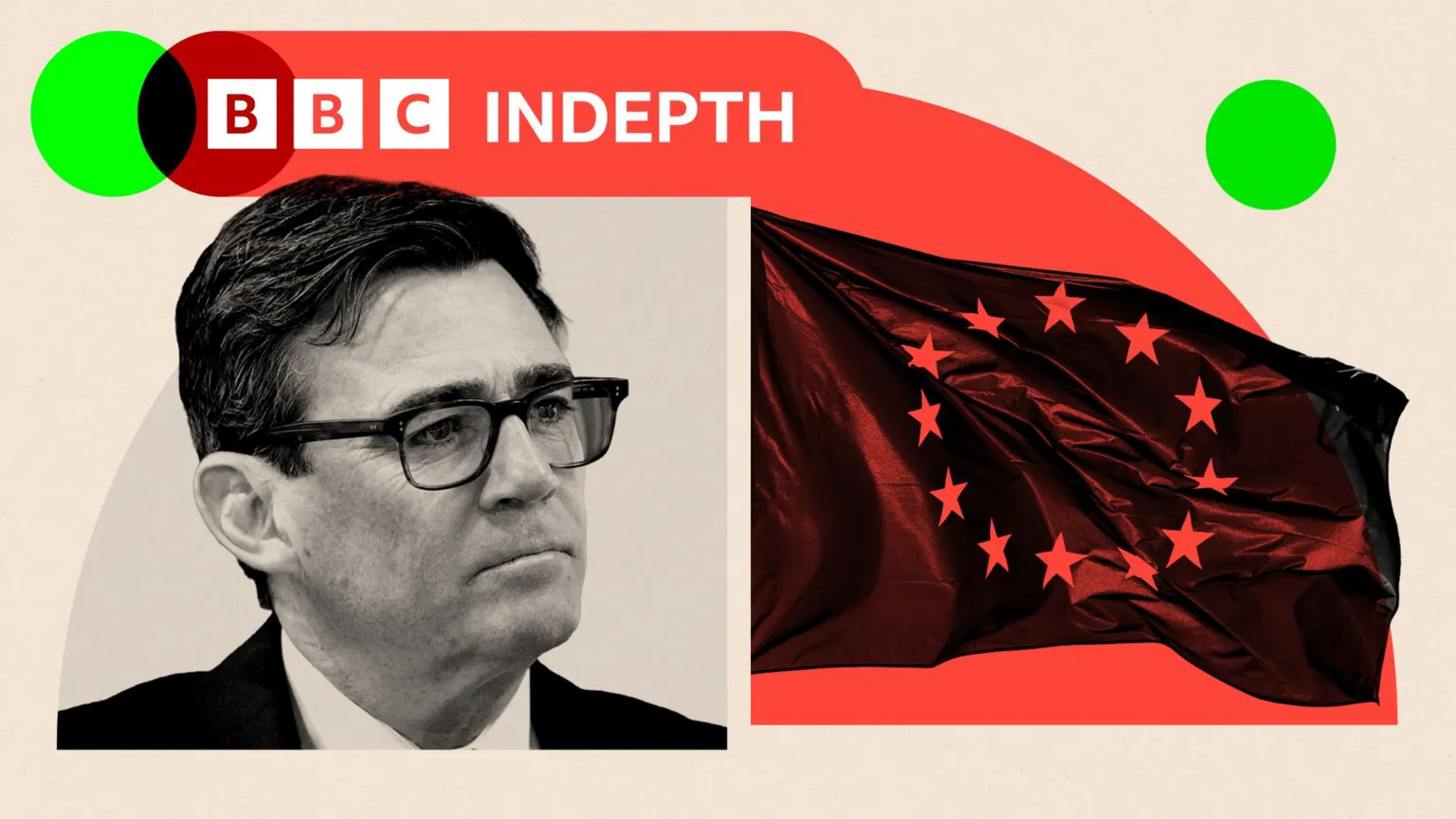

LONDON — Prime Minister Andy Burnham’s push for a closer relationship with the European Union faces a fundamental obstacle that goes unmentioned in his “Emperor’s New Clothes” rhetoric: the EU Britain left in 2020 is not the EU it would be re-engaging with in 2026.
Burnham will tell the Lord Mayor’s Banquet on Monday that “the Brexit we were given has not worked” and that Britain has “lost more than we have gained,” ahead of a reset summit in Brussels on Friday . But the bloc he is courting has undergone a profound transformation since Brexit—one shaped by war, energy insecurity, and the looming prospect of far-right governments in several key member states.
A Bloc Forged by Ukraine
The most consequential shift is defence. Russia’s full-scale invasion of Ukraine in 2022 transformed the EU’s security posture, bringing the UK and the bloc closer together in response to a shared threat . The EU adopted its Strategic Compass in 2022, launched six new civilian and military missions, and significantly expanded the European Defence Fund and the European Peace Facility . The UK joined the EU’s Permanent Structured Cooperation (PESCO) military mobility project in November 2022, a small but symbolically significant step .
This security convergence gives Burnham an opening. A substantial British offer on defence cooperation would be “well received and possibly open doors on other issues,” as The Guardian’s editorial board noted . But it also means the EU’s priorities have shifted. Brussels is focused on its eastern flank and on building a defence union that can operate alongside NATO, not on accommodating a neighbouring country’s domestic political needs.
The Far-Right Storm
The EU Burnham faces is also one bracing for political upheaval. Emmanuel Macron will be gone by spring, with polls suggesting his replacement could be a far-right president committed to policies contrary to EU law . Spain’s Pedro Sánchez, Burnham’s closest ideological ally in Europe, could be out by the end of the month, with polls pointing to a coalition including the far right for the first time since Franco . Poland, already beset by constitutional turmoil, could lurch further right in 2027 .
These prospective governments would be hostile to the kind of deep alignment Burnham seeks. A French president committed to “national preference” would hardly welcome closer UK-EU integration that implies accepting EU rules. The political headspace in Brussels for a British reset is shrinking precisely as Burnham tries to expand it.
The Structural Trap: Rule-Taker, Not Rule-Maker
The reset deal being negotiated for Friday’s summit illustrates the fundamental asymmetry. The UK will have a “voice in the room” but no vote on EU food rules, as EU relations minister Hamish Falconer admitted . The agreement could add 0.4 per cent to UK GDP by cutting red tape on food exports and linking emissions trading systems .
But the political price is significant. The deal would require the UK to align with EU rules on food safety and emissions, with an exit clause inserted at Brussels’ insistence in case a future British government reverses course . Critics have warned this makes the UK a “rule taker” rather than a rule maker . The EU, scarred by Brexit, is determined not to offer a relationship that resembles membership without the obligations—a lesson it has applied in its approach to gradual integration for candidate countries as well .
The Bottom Line
Burnham’s calculation is that the economic damage of Brexit—estimated by the OBR at 4 per cent of GDP, and by others at up to 8 per cent—justifies a pragmatic rapprochement . He is right that the status quo is not working for Britain. But the EU he is approaching is one in the midst of its own existential debates: about defence, about enlargement, about whether its liberal order can survive the rise of the far right. The bloc has neither the attention nor the inclination to offer Britain anything resembling the relationship it once had. Burnham may get his deals on food and emissions. But the wider conversation he wants about Britain’s place in Europe will be shaped by forces far beyond his control—and far beyond the “Emperor’s New Clothes” metaphor he deployed.